
🚗 EV Wallboxes in Spain
Installing a wallbox in Spain
Charging your electric car at home – even if the available connection capacity is limited
Installing a wallbox doesn’t automatically mean the contracted power (Potencia Contratada) needs to be increased.
Even with, for example, 5.75 kW of connection capacity, charging an electric car can still be possible — provided the charging power is intelligently adjusted to the house’s current electricity usage.
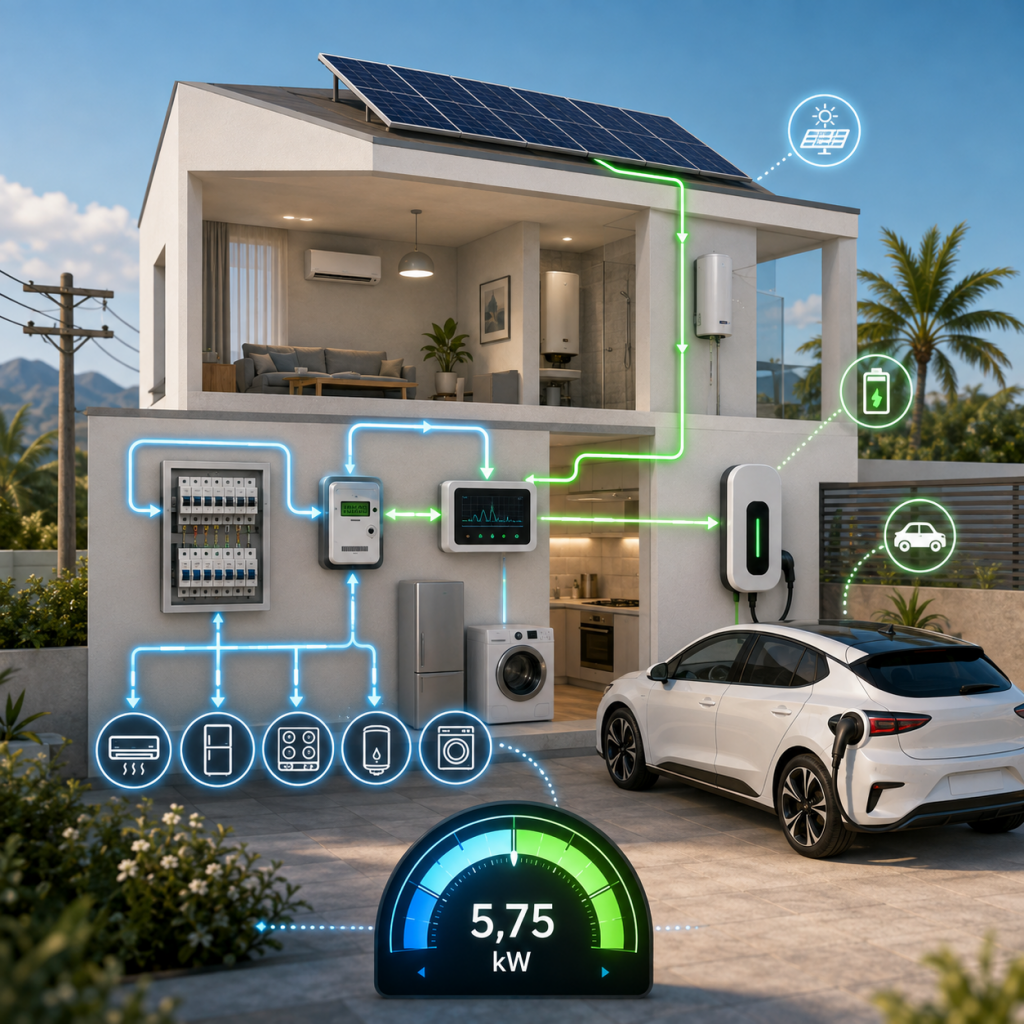
Can I charge my electric car with 5.75 kW of connection capacity?
Yes – with dynamic load management
Many houses and apartments in Spain have relatively limited contracted power.
For example, if your electrical contract has a limit of 5,75 kW, then this is not exclusively available for the electric car. At the same time, the following may also be running:
- refrigerator
- air conditioning
- water heater
- stove
- pool technology
- washing machine
- other electrical appliances
A wallbox rated at, say, 7,4 kW could therefore significantly exceed the power available to the house.
Dynamic load management can be the solution.
How does dynamic load management work?
The wallbox automatically adjusts the charging current
The system monitors the house’s current electrical load and adjusts the electric car’s charging power accordingly.
Example with 5,75 kW of contracted power:
Low household load → more power is available for the car
Water heater switches on → the wallbox automatically reduces the charging current
Water heater switches off again → the wallbox can increase the charging power again
This way, the available connection capacity is used as efficiently as possible, without constantly exceeding the contracted power.
Do I need to increase my connection capacity?
Not necessarily
Whether a capacity increase (Potencia) is required depends on the desired charging power, the existing house connection, and the rest of the electrical load.
In many cases, load management can be enough.
On the other hand, if you want to charge regularly at high power while running many other appliances at the same time, increasing the contracted power may make sense.
In that case, it must also be checked whether the existing electrical installation and documentation are suitable for the desired power.
Wallbox in an underground garage
A parking space in a residential complex can also be a solution
A wallbox doesn’t necessarily have to be installed at a single-family home.
A dedicated charging point can also be possible for a parking space in an underground garage or shared garage.
In that case, however, the local conditions and the requirements of the residential complex must be taken into account. In particular, the electrical infrastructure, cable routing, metering/supply setup, and the Comunidad’s regulations need to be checked.
Which wallbox is the right one?
Not every wallbox is suitable for every electrical installation
Factors that play a role in the selection include, among others:
- the existing house connection
- single-phase or three-phase supply
- contracted power
- desired charging power
- cable length and cross-section
- circuit protection
- residual current protection
- surge protection
- an existing PV system
- battery storage
- dynamic load management
- location of the wallbox
The combination with a photovoltaic system is particularly interesting.
Wallbox and solar power
Using your own solar power for charging
If a photovoltaic system is already in place, the wallbox can be integrated into the energy system in such a way that as much of the solar power generated as possible is used to charge the vehicle.
Depending on the system, PV generation, household consumption, battery storage, and the wallbox can be considered together.
This can be especially worthwhile if the vehicle is regularly at home during the day.
Safety when charging
A wallbox is more than just a higher-power socket
Charging an electric car involves a comparatively high and long-lasting electrical load. That’s why the electrical installation needs to be properly inspected before installation.
A functioning earthing and protective conductor system is particularly important here. During charging, the wallbox and the vehicle monitor various protective conditions. Inadequate earthing or excessive earth resistance can therefore mean the charging process is never even enabled in the first place.
Before installation, the following must be taken into account and/or checked, among other things:
- the earthing system and earth resistance
- protective conductors and protective conductor connections
- residual current protection
- a suitable circuit and its protection
- cable cross-section and cable routing
- surge protection
- the requirements for charging equipment under ITC-BT-52
- dynamic load management, where applicable
A wallbox should therefore not simply be connected to an existing circuit. What matters is that the installation’s overall protective system works reliably.
Especially with older installations, an inspection of the earthing system may be necessary before a wallbox can be safely installed.
What is checked during installation?
A technical inspection comes before installation
Before installing a wallbox, I check, for example:
- the existing connection capacity
- the condition and layout of the electrical distribution board
- possible cable routes
- the required cable cross-section
- circuit protection
- residual current protection
- earthing and protective conductors
- surge protection
- options for dynamic load management
- any existing PV or battery systems
This makes it possible to clarify, before installation, which solution makes technical sense and how much power is actually available.
Have a wallbox installed
Charging at home – tailored to your electrical installation
Whether it’s a single-family home, an apartment, an underground garage, or a holiday property: I inspect the existing electrical setup and work together with you to develop a solution that matches your connection and your actual charging needs.
This isn’t about installing as much charging power as possible, but about making sensible use of the existing electrical infrastructure and extending it safely.
Personal consulting available in German, English, or Spanish.