
⚡ Surge Protection
Surge protection – protecting your electrical installation and electronics
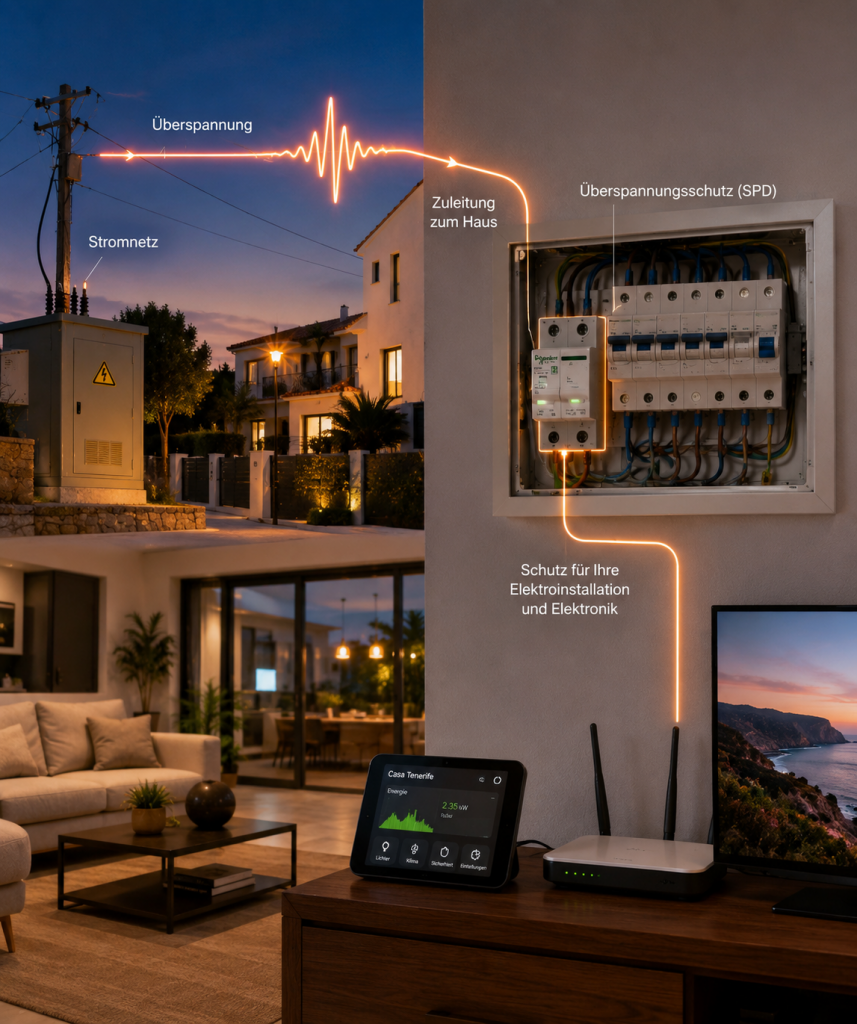
Protection against overvoltages – for the installation and sensitive electronics
Overvoltages can be caused by lightning strikes, switching operations in the power grid, or faults in the grid. They can damage electronic devices and, especially in modern installations with solar power, battery storage, a wallbox, or smart home systems, cause significant damage.
As an Electricista Autorizado, I check whether the existing electrical installation has suitable surge protection and whether it has been properly integrated into the installation’s overall protection concept.
Is surge protection mandatory in Spain?
Surge protection in Spain: what’s actually required?
In Spain, the requirements for surge protection don’t come exclusively from the REBT. In addition to ITC-BT-23, depending on the connection and grid situation, the Normas Particulares, or the connection conditions of the respective grid operator, must also be taken into account.
This isn’t just about brief transient overvoltages, for example caused by lightning strikes or switching operations. Temporary, or longer-lasting overvoltages, for instance resulting from grid faults, must also be taken into account when selecting protective measures.
Which protective devices and which levels of protection are required therefore depends on the specific installation, the grid connection, and the applicable connection conditions.
Two important types of overvoltage
Transient and temporary overvoltages are not the same thing
When planning surge protection, a distinction must be made between different types of events.
⚡ Transient overvoltages
These are very brief voltage spikes, caused for example by:
- lightning strikes
- switching operations
- events in the supply grid
This is where the classic SPD (Surge Protective Device) comes in.
⚠️ Temporary, or longer-lasting overvoltages
These are longer-lasting overvoltages, often referred to as permanent overvoltages, which can occur, for example, due to faults in the grid.
A typical example is a neutral conductor fault, which can cause significant voltage shifts in a three-phase system.
For faults like this, a conventional surge arrester designed for transient events isn’t automatically the right protective measure. Depending on the installation, appropriate monitoring and disconnection devices may need to be considered instead.
Photovoltaic systems: surge protection on the DC side too
For a photovoltaic system, the protection concept doesn’t stop at the AC side.
In addition to the AC side, the DC side between the PV modules and the inverter must also be considered. Additional REBT requirements apply to grid-connected generation systems, in particular ITC-BT-40. That’s why, for a PV system, the DC side between the PV array and the inverter must be included in the surge protection concept alongside the AC side.
In practice, this means: for a PV system, the entire system needs to be considered — the PV array, DC cabling, inverter, AC side, earthing, and equipotential bonding.
Especially important: wallboxes
Additional requirements apply to charging equipment
For installations used to charge electric vehicles, surge protection is a particularly relevant topic.
ITC-BT-52 explicitly sets out requirements for charging infrastructure regarding protection against temporary and transient overvoltages.
This is especially relevant for:
- private wallboxes
- wallboxes in garages
- charging points in Comunidades
- commercial charging infrastructure
- multi-point charging installations
Is surge protection already in place?
A glance at the distribution board isn’t always enough
The presence of a device doesn’t automatically mean the installation is optimally protected.
An inspection may, for example, look at:
- Is an SPD present?
- What type has been used?
- Is the device correctly connected?
- Is the protective measure suitable for the installation?
- Are the necessary cable runs and connections properly executed?
- Are there other electrical or communication cables that should be taken into account?
- Is the surge protection functional, or does it indicate a failure or a trip event?
Especially for older installations, retrofitting can be worthwhile.
When should surge protection be checked?
For example:
- during a refurbishment or extension of the electrical installation
- when installing a photovoltaic system
- when installing a wallbox
- with a smart home system
- after repeated damage to electronic devices
- when buying an older property
- when the existing distribution board is being modernized
Electrical check or surge protection inspection?
Which inspection makes sense?
The electrical check looks at the electrical installation as a whole.
A targeted inspection of the surge protection, on the other hand, focuses specifically on the existing protective measures against overvoltages.
If you’re having a comprehensive electrical check carried out anyway, surge protection can be assessed as part of that.
Is your electrical installation adequately protected against overvoltages?
Especially for older properties or modern installations with solar power, battery storage, a wallbox, and smart home systems, it’s worth taking a look at the existing protection concept.
I check the existing protective measures and explain clearly whether, and where, action is needed.
Personal consulting available in German, English, or Spanish.