
⚡ Residual Current Protection (RCD)
Residual current protection – protection when it really matters
Residual current protection – protection when it really matters
A residual current device (RCD) can protect people from dangerous electric shock currents and limit damage caused by faults in the electrical installation. Even so, older Spanish installations often turn out to have RCDs that are missing, incorrectly connected, or not working reliably.
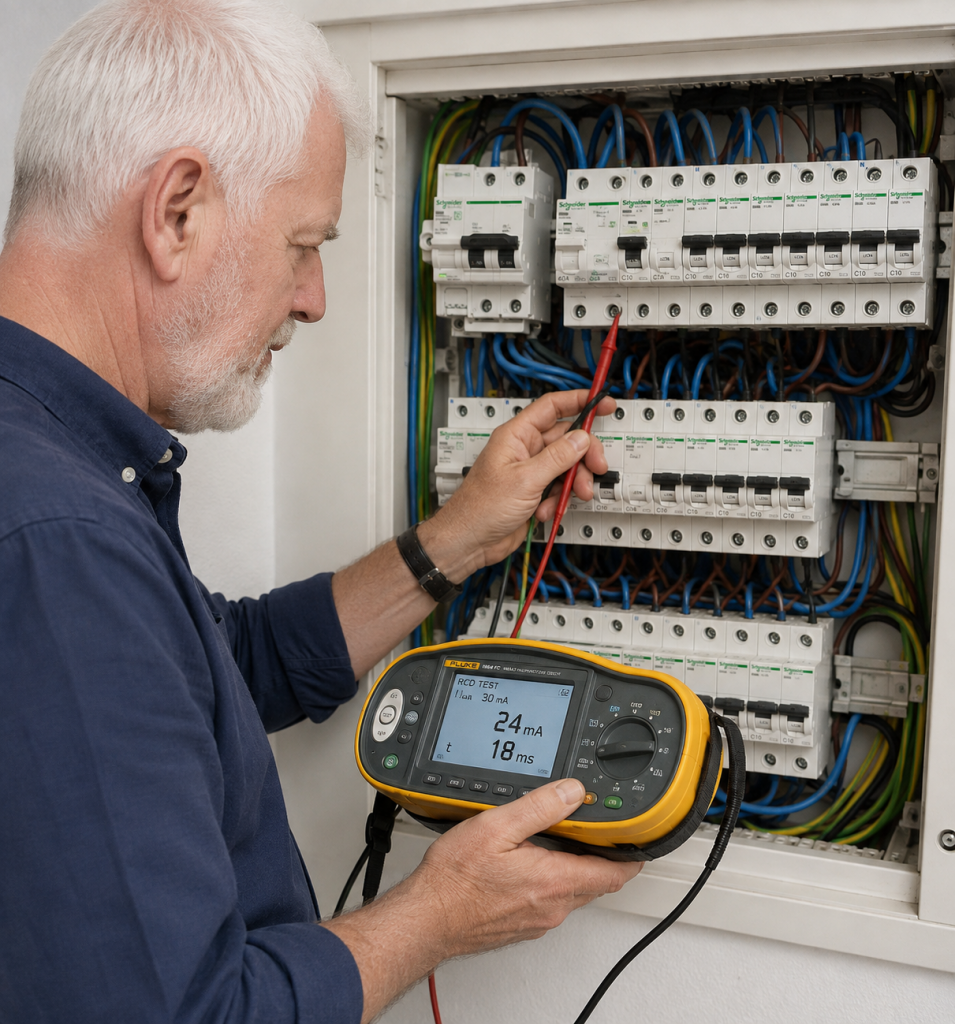
I test existing RCD protective devices and assess whether the installation’s residual current protection is technically sound and reliable.
.
What does an RCD do?
The protection is based on a simple idea
An RCD compares the outgoing and returning current. Under normal operation, both are equal — the sum of the currents through the RCD is zero. If part of the current flows away, for example via the protective conductor or through a person to earth, a difference arises. Once this difference becomes large enough, the RCD trips.
What is checked when testing residual current protection?
Not just pressing the test button
The test button on the RCD is important, but it’s no substitute for a professional inspection.
Depending on the installation and the scope of the inspection, the following can be checked, among other things:
- existing residual current protective devices
- trip current
- trip time
- correct assignment of circuits
- function of the protective measure
- detectable installation faults
- condition and labeling of the distribution board
The specific checks carried out depend on the existing installation and the particular inspection requested.
Common problems in older installations
When the RCD keeps tripping
A common problem is an RCD that appears to trip “for no reason.”
This shouldn’t simply be fixed by repeatedly switching it back on or replacing the RCD.
Possible causes can include:
💧 Moisture Moisture can cause insulation problems and lead to residual currents.
🔌 Faulty appliances A connected appliance can itself be the cause.
⚡ Faults in the installation Damaged cables or faulty connections can also cause tripping.
🔧 Changes or extensions Circuits that have been modified afterward can cause problems, especially if the assignment or wiring wasn’t done correctly.
The RCD keeps tripping – what now?
Don’t bypass it or just keep switching it back on
If an RCD trips repeatedly, the cause should first be identified.
I systematically narrow down the fault and check whether the cause lies in a connected appliance, a single circuit, or the electrical installation itself.
A tripped RCD is often not a fault of the RCD itself — rather, it’s a sign that there may be a fault somewhere in the system.
Residual current protection in Spain
Characteristics of older electrical installations
Especially in older properties in Spain, you often find electrical installations that have been altered, extended, or partially renewed over many years.
As a result, today’s distribution board can be considerably more complex than the original layout would suggest.
That’s why an inspection isn’t just about whether an RCD is fitted somewhere, but about whether the existing protective measures work sensibly together as a complete system.
What is the difference between FI, RCD, and “differential” switch?
Several terms — essentially the same family of devices
In Germany, people commonly refer to the FI-Schutzschalter or RCD.
In Spain, the term Interruptor Diferencial, or simply diferencial, is commonly used.
These different terms can be confusing, especially for German property owners in Spain.
Electrical check or a targeted inspection of the RCD protection?
Which service is the right one?
If you’d generally like to know how your entire electrical installation is doing, an electrical check is the more suitable service.
If, on the other hand, you have a specific problem with the RCD — for example, repeated tripping — the focus should be on fault-finding.
If you specifically want to know whether the existing residual current protection is working, we can also inspect that particular protective measure specifically.
Is your residual current protection reliable?
Whether you’d like to have an older electrical installation checked, an RCD keeps tripping, or you’d like to get a clear picture before buying a property:
I inspect the existing protective measures and explain clearly what the test results mean.
Personal consulting available in German, English, or Spanish.